Showing posts with label recipes. Show all posts

25 October 2013

Suffritto di Pollastri—Renaissance Saffron Chicken


We promised you a recipe from De Arte Coquinaria, the famous cookbook written in the 1460’s by Maestro Martino da Como, chief cook to the Pope and many other nabobs of Renaissance Italy. I found one I liked but it’s had to wait until I could find a bottle of agresto, known as verjus here in France. They still make it nearby in Périgord, where some folks deglaze their pan-fried foie gras with it, but usually you can only find it in the fancy shops.

Here’s what Maestro Martino was cooking for the nabobs:

Per fare un suffritto de carne, o de pippioni,
 o de pollastri, o capretto.
In prima nectali molto bene et tagliali in quarti, o vero in pezzi 
piccholi, et poneli in una pignatta a frigere con bono lardo voltando 

spesse volte col cocchiaro. Et quando la carne è quasi cotta getta
fore la maiore parte del grasso de la pignatta. Et dapoi togli de
bono agresto, doi rosci d'ova, un pocho pocho de bono brodo et 
de bone spetie, et meschola queste cose inseme con tanto zafrano 
che siano gialle et ponile in la dicta pignatta inseme co la carne et
 lasciali bollire anchora un pocho tanto che tutte queste cose ti parano 
cotte. Dapoi togli un pocho pocho de petrosillo battuto menuto et
 ponilo insieme col ditto soffritto in un piattello et mandalo ad tavola. 
Et questo tale soffritto vole essere dolce o agro secundo il gusto 
comuno o del patrone.

(To make a soffrito of meat, or of pigeon, or of poultry, or kid

First clean them very well and cut them in quarters, or else in small pieces, and put them in a pan with some good lardo, turning them often with the spoon. And when the meat is almost cooked throw out most of the fat from the pan. And then take some good verjus, two egg yolks, a little bit of broth and some good spices; mix these things together with enough saffron to make it yellow and put them in the pan with the meat;  let it boil until they seem well cooked to you. Then take a little bit of chopped parsley and add it to this soffritto on a platter and send it to table. And this soffritto may be sweet or tart depending on common agreement, or the boss’s taste.)


Dead simple, and intriguing; we’ll try it with a chicken.  A soffrito, which now means frying a mix of onion, garlic, parsley etc to start a dish,  for Maestro Martino was just a technique of slow-frying. For lardo he would have meant rendered lard, or maybe something like bacon grease.  I’m going for duck fat.  Like everyone else here, I have a tub of it in the back of the fridge for frying potatoes (This is always part lard anyhow; they have to top up the duck fat to cover the confits. And it’s still the best stuff in the world)

The ‘good spices’? Martino doesn’t say so we’ll have to guess from the medieval repertoire.

But before I can get the recipe down, the computer tells me someone has already done it for me—an absolutely wonderful site called Medieval Cuisine, run by Euriol of Lothian (Cassandra Baldassano) and her friends in the Society for Creative Anachronism. You can see her interpretation of the recipe here; mine differs only slightly.


a chicken, cut in fourteen pieces
duck fat, or lard, or olive oil
verjus
two egg yolks
chicken broth (cube is fine)
1 dose saffron
ground cloves (6) and ground cardamon (seeds from a dozen pods); black pepper and 1T or more ginger
parsley

Fry the chicken on medium heat until it’s almost done, with some colour on the skin. Reduce the fat if you must. Mix the other ingredients and throw them in, turn the heat down low and finish. Garnish with the chopped parsley.


Fine-tune this to please your taste (or your boss’s). If you dust the chicken with just a tiny bit of flour first, you’ll get a thicker sauce. After frying, start with just a little chicken stock, and add more if it’s getting dry. As Martino hints in the last sentence, the quantity of verjus is critical. A quarter cup will make it tart indeed, a little like lemon chicken. If you don’t want that, use less, and perhaps add a bit more of the ‘good spices’. Or you might temper the verjus with a teaspoon of sugar; we might try that next time.


And there will be a next time, ‘cause this was a treat. Maestro Martino, grazie mille!


14 October 2013

Franco-Italian (con)Fusion: Tagliatelle al Confit de Canard


When we had written about every square inch of Italy, we were ordered by our publisher to leave Umbria for southwest France, where there were several surprises, starting with the price of truffles. In Umbria’s Valnerina, where we lived, even impecunious travel writers could occasionally splurge on spaghetti al tartufo nero in a trattoria; in the Lot, even though we live a mere 45 minutes from the big truffle market in Lalbenque, they are a pricey indulgence reserved for times when someone else is paying.

What compensated for the paucity of truffles was the omnipresence of duck, and to a lesser extent goose. Fatted duck, to be precise, to make foie gras, and along with the foie gras come numerous duck by-products, most importantly the maigret, or breast (usually grilled like a steak), and the thighs (cuisses) and gizzards (gésiers), which are put up in jars or tins and slowly cooked in their own fat and preserved as confits de canard; the gizzards end up in a salade quercynoise with lettuce and walnut oil, and maybe some smoked duck breast or ham.

Even the duck carcasses, curiously known as demoiselles, are preserved, and barbecued in the summer by the locals at the ferme auberges, restaurants run by farm families—in the southwest, they’re nearly always on duck farms.

Jewish communities in Venice introduced a similar dish to the Veneto. Oca in onto (goose preserved in fat) is pretty much the same thing as confit d’oie; the onto of course, being a tasty substitute for forbidden lard in soups, sauces and other dishes. The Jews also make elaborate dishes such as frisinsal de tagiadele: tagliatelle cooked in a rich chicken stock, with goose salame or meatballs, or even shredded roast chicken, pine nuts and sultanas, all baked in the oven in the shape of a ring (more or less; recipes vary widely).

My own recipe that is much simpler, invented one day when there were four for dinner, but only two confits in the fridge. The solution: put them on pasta. Eccoci qua! Voilà!


Proportions are to your own taste but in general what you need for four servings are:

4 cloves of garlic, chopped
400 gr mushrooms, thickly sliced. Even better if you have shitakes or porcini
A few big spoonfuls of duck fat (remember this is the ‘other olive oil’ and good for you!)
Two duck confits
Big handful of parsley, chopped
Salt and pepper
Truffle oil (if you want to be fancy)
A small carton of thick cream (roughly 20cl, or 6-7 fluid ounces)
Tagliatelle for four

If your confits are in a tin, open it and place on a low flame until you can extract the meat from the liquified fat. Take off the fatty skin and give it to the cat (if they are a French cat like our Brutus, they will insist on it!). Shred the meat from the bone, which is easiest done with your fingers, but really greasy.  Half way through this, the phone will inevitably ring…

Meanwhile, boil the water for the pasta, as the sauce takes about ten minutes.

Use some of the duck fat to sauté the garlic. Store the rest of the fat in the fridge in a sealed container to sauté potatoes.

When the garlic is soft, add the mushrooms and fry until soft. If they seem too dry, throw in a knob of butter.

Add the shredded confits to the mushrooms. Remember they they're already cooked so only need to be heated through; when warm, add the cream, then salt. Keep warm until the pasta is al dente. Toss in a few spoonfuls of the cream from the sauce, then top with the confits and mushrooms and a twist or two of the pepper mill, chopped parsley, and if you like, drizzle with truffle oil, to remind yourself of the good old days in Umbria. 

23 August 2013

Eating the Enemy, Part II


           The more we got to know about purslane, the greater our wonder and respect for it. It has an astoundingly high level of omega-3 fatty acids, more than any other vegetable. And omega 3’s are very fashionable these days. Purslane is loaded with vitamins, especially vitamin C and E, along with lots of healthy minerals and antioxidants. Doctors have been singing its praises since antiquity, for countering inflammation, sore throats, ulcers and earaches. It’s good for the heart and the joints. Put some in a poultice on your bee stings and boils. 

Even in the  garden, purslane’s fans claim it is the most virtuous of weeds. It makes good ground cover to hold moisture in the soil, and breaks up soil to help plants with less robust roots. (Maybe so, but if you let it, it will take over everything. Everything.)

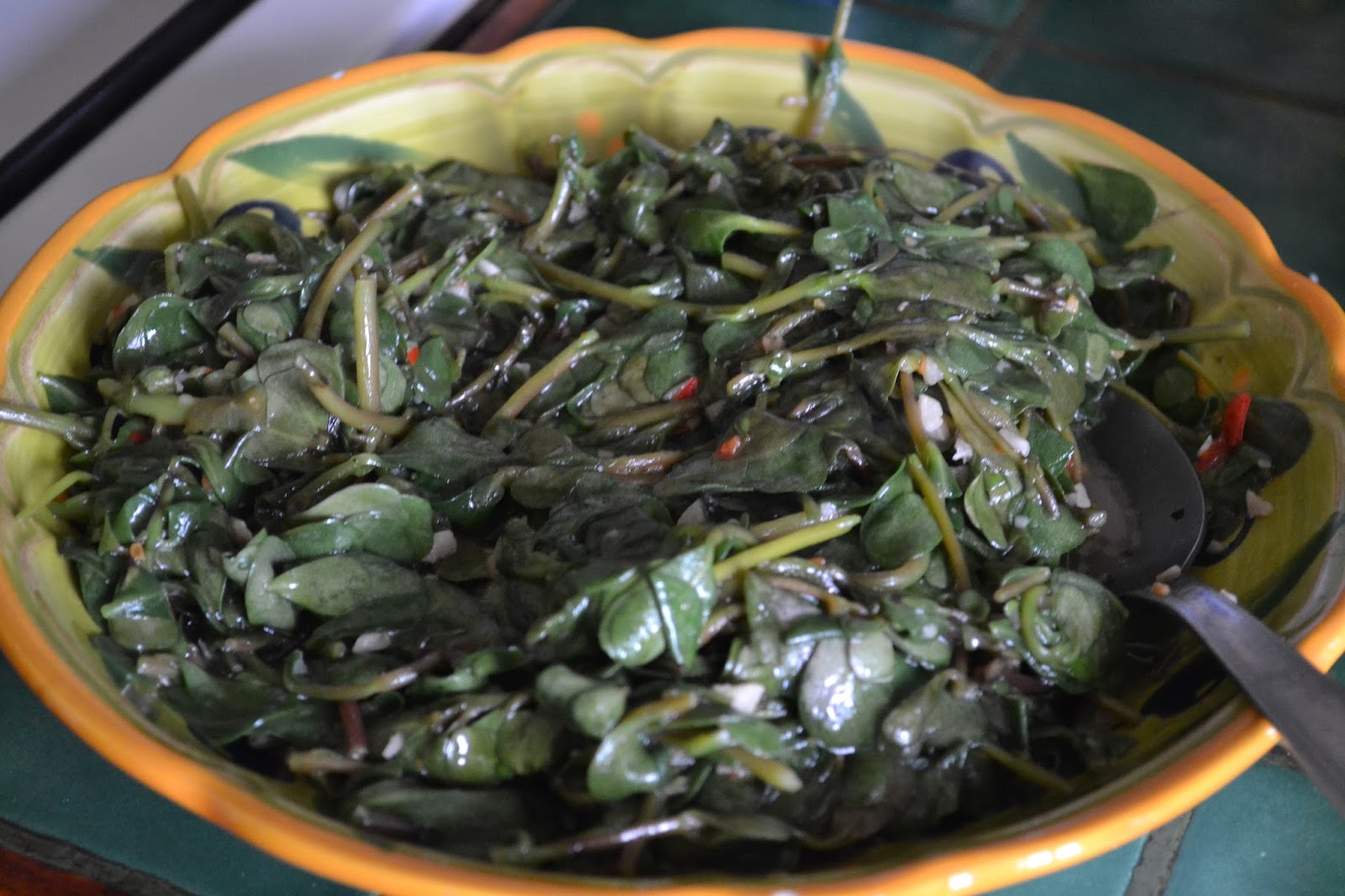
There’s been no rain for two weeks now, but the purslane just keeps coming. It’s time to yank some up and cook it. Everyone who has ever used the stuff recommends picking it in the morning. The plant employs an unusual sort of photosynthesis; it does its work at night, storing up nutrition in the form of a slightly acidic chemical, which it converts to sugars over the course of the day. Get it in the morning while it’s still tart.

This we do. We have to cut off the roots and soak it; growing next to the ground it picks up a lot of dirt. Italians have been eating porcellana (also called portulaca) forever. The Milanese Bonvesin de la Riva mentions it in his list of foods in his 1288 Marvels of the City of Milan.  But we haven’t found a lot of compelling recipes for it.  So we try it the most common way: like any other green, sautéed with a little garlic and olive oil (and a chopped chilli, because that’s the way we are). It looks about like any other green when it’s done, but I have to admit we were a little disappointed by the taste. The tartness disappeared, and a  blandness replaced it. Fortunately we didn’t cook it too long. That’s the worst mistake you can make; after about five minutes on the stove a sort of gluey texture starts to emerge—not nice. Five minutes is just about right.


            One cookbook suggests making a sauce for meat or fish: mash up a bunch of it, with an egg white, an anchovy and some oil. Others remind us that  the country folk used to make it  sott’aceto, preserved in vinegar. Everyone else seems to limit it to salads: with cucumber, with tomato, beetroot, beans, lentils or whatever.  There’s a nice one (in Italian) involving cold chicken, basil, pistachios, shaved grana padano and red currants.

            Bottom line—it’s absolutely fine in salads, though it will never be a star. You can leave the smaller stems in, and there doesn’t seem to be any difference in taste between the young shoots and the full-grown monsters.

            The Italians haven’t provided much inspiration, so we looked to see what the French do with their pourpier. Back in Roman times, Pliny oddly referred to it as ‘Gallic asparagus’, which suggests it was somewhat prized. And Gallic pourpier, after all, is what’s menacing my garden. But the French were no help; all they do is purée it for a soup, a velouté, like they do with everything else.

Next year the purslane will certainly be back, and we’ll be trying  a Mexican favourite, pork and purslane, or the Lebanese salad called fattoush, with lots of mint and lemon juice,  or this very intriguing Indonesian salad.

Finally, all you gardeners be advised that purslane has an evil twin. The false purslane is called ‘creeping spurge’. it is nearly as common and mildly toxic. Almost as soon as I learned this I noticed, yes indeed, we’ve got that in the garden too. But the leaves are smaller and flatter, and grow in pairs. It’s not hard at all to tell the difference


12 August 2013

The Naked and the Ill-formed


It won’t be love at first sight. Even a glowing description wouldn’t set your taste buds on fire. But you won’t be sorry you tried them. Malfatti means ‘badly made’, and the charm of these dumplings seems to be in squeezing them into shape by hand any which way—they’re never supposed to be completely tidy and uniform like their cousins, the gnocchi (in some corners of the northwest they sometimes call them gnocchi verdi, ‘green gnocchi’).

            Essentially, a malfatto is the common stuffing used for ravioli or tortelli: spinach and ricotta, bound with eggs, and some nutmeg and parmesan thrown in—only without the pasta cover.  In much of Tuscany, the same thing is logically called gnudi, or ‘nudies’ (malfatti in Siena, gnudi in Florence ; it’s a local thing). Some restauranteurs in Napa, California claim that their mother invented them in 1925, but the Italians say they come from Lombardy, where they’ve been making them for centuries.

            They’re pretty trendy now, both in Italy and the U.S. Malfatti are easy to make, and offer a great alternative to pasta for a primo, or a good lunch all by themselves along with a salad.  The most popular recipe has them with slightly browned butter and sage on top. They’re perfect like that, but up in Lombardy they will also put mushrooms cooked in butter on top, or even a tomato and meat ragú.

Here’s Dana’s basic recipe for malfatti:

This recipe is very forgiving,  and can be easily adjusted to what you have in the garden or fridge.


1 firmly packed cup of greens (whatever you have in the garden will work; this one is a mix of chicory, chard, amaranth and spinach); boiled,  drained, squeezed and finely chopped

garlic cloves, minced (if you like garlic, put in five; if you don't put in less)

1/2 cup green onions or chives, or both, minced

a handful of fresh basil leaves (if you have them)

250 gr ricotta

1/2 cup grated Parmesan

1 cup breadcrumbs or flour. Breadcrumbs make a lighter version

a big pinch of nutmeg

2 eggs, beaten

salt and pepper to taste

flour for dredging

5 tbs butter

a dozen or more sage leaves

grated Parmesan


—Sauté the garlic in a bit of olive oil and mix in the greens.

—Mix in the onions/chives, ricotta, Parmesan, breadcrumbs, garlic, nutmeg, eggs, salt and pepper to make a stiff dough. Refrigerate for a few hours or overnight.


—Preparation: heat salted water to a boil as you roll the dough into logs about 4cm in diameter on a floured surface. Slice, making sure each dumpling is lightly coated with flour, and drop into boiling water (it usually takes four or five batches). Take them out as they float to the surface and put under a low grill to keep warm and lightly brown while cooking the other batches.  This light grilling, it must be said, is not canonical, but it gets rid of the slightly slimy surface and makes the malfatti much nicer,  at least at our house.

—Meanwhile gently heat the butter and sage until the butter is light brown and sage turns dark. Drizzle over the malfatti, top with Parmesan and serve warm.


Here’s a recipe that may more nearly approximate the original rustic malfatti, with old bread soaked in milk instead of flour or breadcrumbs (recipe in Italian here