Showing posts with label Italy. Show all posts

27 April 2014

Anyone for frattaglie?


                                                           a traditional carnacuttaro (photo: alexdevil)

The exasperating, confusing and delightful city of Naples is the kind of place that leaves memories unlike any others. A lot of ours, from back in 80’s when Naples was rather more Neapolitan than it is now, involve the streets of decaying palazzi and bad hotels around Piazza Garibaldi and the train station. Frantic, louche, grimy and full of surprises, the gargantuan piazza was lined with trattorie, most of them pretty good—some of them still are. Market stands sold contraband Marlboros and contraband cassettes. Once I watched a gaggle of street children with firecrackers, trying to toss them through the windows of passing police cars. 

On many occasions, this piquant world was our home. The hotels were full of character, like the Fiore on Via Milano, the one with the world’s fattest cat, signs in Polish, and a tiny elevator that required an obsolete aluminum ten lira coin before it would consent to move. Even the place that (we later found) more commonly rented by the half-hour tried to smarten itself up a little when a nice young American couple with a baby appeared. Family atmosphere, Neapolitan style. 

One constant fixture on the Piazza, at the corner of Via Milano, was a little three-wheeled farm truck with a custom-built white platform on the back. The platform was built up on steps as a kind of Busby Berkeley wedding cake, each level edged with green plastic foliage. Each bore a row of steel spikes, on which were arrayed pale, boiled pieces of pig: trotters, snouts, organs, testicles, and others we could only guess. Above each, at a rakish angle, was a neatly impaled slice of lemon. 

You couldn’t take your eyes off it. And we couldn’t bring ourselves to ever try it either. They say the taste for frattaglie (offal) goes back to the Bourbon monarchy, when the king’s French cooks would toss the nasty bits off the palace balconies to the Neapolitan rabble, shouting Voila les entrailles! Hence another local name for offal, zendraglie

Today though, the smuggled Marlboros and the street boys of Piazza Garibaldi are gone, and so is the carnacuttaro, or pere e musso (‘foot and snout man’, as people called them) of Piazza Garibaldi. Nowadays the sellers of frattaglie in Campania and beyond are most commonly seen around Sarno and Nocera Inferiore, back behind Vesuvius, where they are a fetish dish, and everywhere else at parish and village festivals, when people’s folkloric feelings sometimes overcome more modern tastes. They chop up the bits and serve them in a paper cup with a skewer and your choice of fennel or lupins or peperoncini. Besides the lemon, the latest fashion is to offer a splash of tequila on top.  

If you can’t find a carnacuttaro on the street or at the festivals, there’s an old shop for frattaglie and tripe that has metamorphosed into a famous trattoria, right in the heart of Naples on Via Pignasecca: Le Zendraglie. But we still haven’t succumbed to the charm. Maybe next time. 

The Forgotten Vegetable


                            Curly kale, decorating the early 16th-century cloister of Cahors cathedral


Try and explain kale to a Frenchman! Chou frisé? ‘I’ve heard of it.’ But he’s never seen it. You can’t find seeds to plant it here, and no restaurant south of the Loire would ever dream of sneaking it into a menu. 

Meanwhile, the humble kale is all the rage among the dissipated yuppies of America’s coastal metropolises. It’s a cultural cycle. In the Depression, their grandmothers badgered their kids into eating it because it was good for you. So their moms wiped the horrible thing out of their memory when good times came back, and now their grown children are rediscovering it and finding it’s not so bad after all, especially when simply sautéed with olive oil and garlic. 


Kale, lowly kale, is the Sinatra of vegetables; it’s been a puppet, a pauper, a pirate, a poet—a pawn and a king. If you’re not familiar, it’s really just a cabbage; the word ‘kale’ is the same as the German kohl or the Dutch kool. Scientifically, it’s the acephala sort of cabbage that does not make a head, just floppy leaves. There are countless varieties, all closer to the original wild cabbages, and they have nourished us at least since Roman times. 

In the Middle Ages, kale was king. All over Europe, it was a staple of the peasant diet. Even so, very few cookbooks even mention it. The nobles didn’t care for vegetables. Things that grew close to the ground were for groundlings. Birds and fruits that lived in the clear air were proper fare for noblemen. 

That didn’t stop kale from becoming a surprise star of Gothic sculpture. One of the most charming features of the great French cathedrals is the way they incorporate familiar common plants into the sculptural schemes of the portals, vaulting and capitals. In the early Gothic it was a celebration of spring. Notre-Dame in Paris is carved in plantain, cress and celandine; look closely at Sainte-Chapelle in Paris, and you’ll see buttercups everywhere. 

In the 15th century, the botanic whim of Gothic art was moving on to other things, including vegetables. The French variety of chou frisé with its elegantly curling leaves fitted the artistic mood perfectly (chicory, thistle and seaweed were popular too). The late Gothic flamboyant style made the old peasant fodder into something elegant and ethereal. There’s lots of it at Rouen cathedral, and closer to us in the Lot, the cloister of Cahors cathedral (see above) is a kale garden in stone. 

Somehow, kale fell out of style. Maybe it was the Reformation and Counterreformation; maybe the importation of such new foods as potatoes and tomatoes from the new world, or more productive round-headed cabbages. Kale held on in Protestant Scotland, Scandinavia, the Netherlands and north Germany. In the Catholic south, it nearly disappeared. In France today it is unknown, and most people use chou frisé to mean Savoy cabbage.  

In Italy, one important variety called cavolo da foraggio is still around, but you won’t Google any recipes for it, though you will find mentions of the plant as ‘food for beasts’. 

We disagree. In fact we planted some in our garden last September, courtesy of the firm Seeds of Italy. It didn’t do anything but grow. By springtime there were leaves like Brobdingnagian dinner plates. They’re tough, but sautée them for about twenty minutes with oil and lots of garlic, and they are pretty tasty. 


Wild sea-kale growing near Plymouth, England (from geograph.org.uk) looks a lot like the Italian cavolo da foraggio we just finished from our garden. 


In Tuscany, at least, they are still very fond of one variety of kale: cavolo nero, or cavolo lacinato, or Tuscan kale. If you’re in a reasonably warm climate, this is a great thing for filling up the spaces that appear in your garden in late summer. For us at least, it soldiered on through the winter and into the following spring and provided a good return with no effort. The only drawback, as with most kale, is that you can cook the central spine of the leaf all day without making an impression. It has to be cut out, which is tedious. 

Tuscans are earnest folk and immune to tedium (spend some time there and you’ll start to notice...). So cavolo nero is a main ingredient in the humble but much-beloved weekday dish called ribollita, so called because it is basically yesterday’s leftovers ‘re-boiled’. We won’t bother with a recipe right now; there are millions of them online, each one different, but the basic principle is always the same: a bunch of kale and a nearly equal amount of verza (Savoy cabbage), chopped onion, tomato, white beans, and breadcrumbs or croutons. And whatever else at the bottom of the fridge you’re trying to get rid of. 

The white beans are a familiar refrain. Along with pork, they’re something that goes naturally well with kale. We’ll try to come up with a good recipe soon. 

25 October 2013

Suffritto di Pollastri—Renaissance Saffron Chicken


We promised you a recipe from De Arte Coquinaria, the famous cookbook written in the 1460’s by Maestro Martino da Como, chief cook to the Pope and many other nabobs of Renaissance Italy. I found one I liked but it’s had to wait until I could find a bottle of agresto, known as verjus here in France. They still make it nearby in Périgord, where some folks deglaze their pan-fried foie gras with it, but usually you can only find it in the fancy shops.

Here’s what Maestro Martino was cooking for the nabobs:

Per fare un suffritto de carne, o de pippioni,
 o de pollastri, o capretto.
In prima nectali molto bene et tagliali in quarti, o vero in pezzi 
piccholi, et poneli in una pignatta a frigere con bono lardo voltando 

spesse volte col cocchiaro. Et quando la carne è quasi cotta getta
fore la maiore parte del grasso de la pignatta. Et dapoi togli de
bono agresto, doi rosci d'ova, un pocho pocho de bono brodo et 
de bone spetie, et meschola queste cose inseme con tanto zafrano 
che siano gialle et ponile in la dicta pignatta inseme co la carne et
 lasciali bollire anchora un pocho tanto che tutte queste cose ti parano 
cotte. Dapoi togli un pocho pocho de petrosillo battuto menuto et
 ponilo insieme col ditto soffritto in un piattello et mandalo ad tavola. 
Et questo tale soffritto vole essere dolce o agro secundo il gusto 
comuno o del patrone.

(To make a soffrito of meat, or of pigeon, or of poultry, or kid

First clean them very well and cut them in quarters, or else in small pieces, and put them in a pan with some good lardo, turning them often with the spoon. And when the meat is almost cooked throw out most of the fat from the pan. And then take some good verjus, two egg yolks, a little bit of broth and some good spices; mix these things together with enough saffron to make it yellow and put them in the pan with the meat;  let it boil until they seem well cooked to you. Then take a little bit of chopped parsley and add it to this soffritto on a platter and send it to table. And this soffritto may be sweet or tart depending on common agreement, or the boss’s taste.)


Dead simple, and intriguing; we’ll try it with a chicken.  A soffrito, which now means frying a mix of onion, garlic, parsley etc to start a dish,  for Maestro Martino was just a technique of slow-frying. For lardo he would have meant rendered lard, or maybe something like bacon grease.  I’m going for duck fat.  Like everyone else here, I have a tub of it in the back of the fridge for frying potatoes (This is always part lard anyhow; they have to top up the duck fat to cover the confits. And it’s still the best stuff in the world)

The ‘good spices’? Martino doesn’t say so we’ll have to guess from the medieval repertoire.

But before I can get the recipe down, the computer tells me someone has already done it for me—an absolutely wonderful site called Medieval Cuisine, run by Euriol of Lothian (Cassandra Baldassano) and her friends in the Society for Creative Anachronism. You can see her interpretation of the recipe here; mine differs only slightly.


a chicken, cut in fourteen pieces
duck fat, or lard, or olive oil
verjus
two egg yolks
chicken broth (cube is fine)
1 dose saffron
ground cloves (6) and ground cardamon (seeds from a dozen pods); black pepper and 1T or more ginger
parsley

Fry the chicken on medium heat until it’s almost done, with some colour on the skin. Reduce the fat if you must. Mix the other ingredients and throw them in, turn the heat down low and finish. Garnish with the chopped parsley.


Fine-tune this to please your taste (or your boss’s). If you dust the chicken with just a tiny bit of flour first, you’ll get a thicker sauce. After frying, start with just a little chicken stock, and add more if it’s getting dry. As Martino hints in the last sentence, the quantity of verjus is critical. A quarter cup will make it tart indeed, a little like lemon chicken. If you don’t want that, use less, and perhaps add a bit more of the ‘good spices’. Or you might temper the verjus with a teaspoon of sugar; we might try that next time.


And there will be a next time, ‘cause this was a treat. Maestro Martino, grazie mille!


14 October 2013

Franco-Italian (con)Fusion: Tagliatelle al Confit de Canard


When we had written about every square inch of Italy, we were ordered by our publisher to leave Umbria for southwest France, where there were several surprises, starting with the price of truffles. In Umbria’s Valnerina, where we lived, even impecunious travel writers could occasionally splurge on spaghetti al tartufo nero in a trattoria; in the Lot, even though we live a mere 45 minutes from the big truffle market in Lalbenque, they are a pricey indulgence reserved for times when someone else is paying.

What compensated for the paucity of truffles was the omnipresence of duck, and to a lesser extent goose. Fatted duck, to be precise, to make foie gras, and along with the foie gras come numerous duck by-products, most importantly the maigret, or breast (usually grilled like a steak), and the thighs (cuisses) and gizzards (gésiers), which are put up in jars or tins and slowly cooked in their own fat and preserved as confits de canard; the gizzards end up in a salade quercynoise with lettuce and walnut oil, and maybe some smoked duck breast or ham.

Even the duck carcasses, curiously known as demoiselles, are preserved, and barbecued in the summer by the locals at the ferme auberges, restaurants run by farm families—in the southwest, they’re nearly always on duck farms.

Jewish communities in Venice introduced a similar dish to the Veneto. Oca in onto (goose preserved in fat) is pretty much the same thing as confit d’oie; the onto of course, being a tasty substitute for forbidden lard in soups, sauces and other dishes. The Jews also make elaborate dishes such as frisinsal de tagiadele: tagliatelle cooked in a rich chicken stock, with goose salame or meatballs, or even shredded roast chicken, pine nuts and sultanas, all baked in the oven in the shape of a ring (more or less; recipes vary widely).

My own recipe that is much simpler, invented one day when there were four for dinner, but only two confits in the fridge. The solution: put them on pasta. Eccoci qua! Voilà!


Proportions are to your own taste but in general what you need for four servings are:

4 cloves of garlic, chopped
400 gr mushrooms, thickly sliced. Even better if you have shitakes or porcini
A few big spoonfuls of duck fat (remember this is the ‘other olive oil’ and good for you!)
Two duck confits
Big handful of parsley, chopped
Salt and pepper
Truffle oil (if you want to be fancy)
A small carton of thick cream (roughly 20cl, or 6-7 fluid ounces)
Tagliatelle for four

If your confits are in a tin, open it and place on a low flame until you can extract the meat from the liquified fat. Take off the fatty skin and give it to the cat (if they are a French cat like our Brutus, they will insist on it!). Shred the meat from the bone, which is easiest done with your fingers, but really greasy.  Half way through this, the phone will inevitably ring…

Meanwhile, boil the water for the pasta, as the sauce takes about ten minutes.

Use some of the duck fat to sauté the garlic. Store the rest of the fat in the fridge in a sealed container to sauté potatoes.

When the garlic is soft, add the mushrooms and fry until soft. If they seem too dry, throw in a knob of butter.

Add the shredded confits to the mushrooms. Remember they they're already cooked so only need to be heated through; when warm, add the cream, then salt. Keep warm until the pasta is al dente. Toss in a few spoonfuls of the cream from the sauce, then top with the confits and mushrooms and a twist or two of the pepper mill, chopped parsley, and if you like, drizzle with truffle oil, to remind yourself of the good old days in Umbria. 

5 September 2013

Another Odd Thing That Italians Eat


                                        —Fabiana Geomangio

We were in Rosciano, our hamlet in Umbria, at a dinner party when we were first offered tidy rectangles of toast topped with a dark brown paste that had a delicately pungent, liver-like taste. Informed that they were called ‘Crostini di milza’, we happily munched on them on several other occasions in Umbria and Tuscany before actually remembering to look milza up (this was back in the pre-internet era). We discovered that it meant ‘spleen’.

Spleen! Isn’t that the organ of ill temper, the one that one must periodically vent?

Must I observe you? must I stand and crouch

Under your testy humour? By the gods

You shall digest the venom of your spleen.

—Shakespeare, Julius Caesar

Even in awfully offal-ly France, where the thymus gland of the calf (ris de veau) is one of the stars in the gourmet constellation, you never see spleen (rate) in a butcher’s or on a menu, or at least we never have. Of course there is the great Charles Baudelaire’s Spleen de Paris, but you wouldn’t want to eat that, either:

“Nothing is as tedious as the limping days,
When snowdrifts yearly cover all the ways,
And ennui, sour fruit of incurious gloom,
Assumes control of fate’s immortal loom”

But spleen is not all bad. In traditional Chinese medicine, one of its functions is to house the yi (thinking). It governs pondering—something Baudelaire might have held a world record for. In Greek, the language that gave us the English word ‘spleen’, people who are good hearted are ‘good-spleened’. And the Greeks eat their share: lamb’s spleen is one of the organs in the Easter dish, kokoretsi, braided into intestines and grilled on a spit (kukurek in Macedonian, kokoreç in Turkish). In southern Italy, in fact, they makes something similar, be it marro (Puglia), cazzmarr (Marche and Basilicata) or cazzamarro (Calabria), among other names.

Other regions of Italy partake as well. In Trentino, they use spleen to make gnochetti with greens, garlic, bone marrow and egg. In Alto Adige they make milzschnittensuppe (beef broth poured over spleen-covered crostini). And Rome's Jewish community makes milza di bue in padella (sautéed ox spleen).

But it’s in Sicily where spleen triumphs in Italy as soul food, especially in Palermo, where the locals are said to have learned their love of spleen (or meusa as it’s known there) from the city’s Jewish butchers, who slaughtered the animals in the Vucciria market, and were paid in offal instead of money. To turn it into cash, they set up stands along the street, boiling and frying the sliced spleen, or stuffing it in rolls. Today it’s called 'pan cà meusa' and served with a squeeze of lemon, ricotta and grated caciocavallo cheese.

For first time spleen eaters, though, you may want to stick with Tuscany and Umbrian crostini di milza. If you can get the spleen, it’s easy to make with butter, red onions, nutmeg and anchovy paste and a food processor: Marco Tomaselli reveals all in this short video:


23 August 2013

De Arte Coquinaria


                                                                             making agresto (verjuice)

While researching the Menu Decoder, we found ourselves looking into a lot of early cookbooks. They’re good fun, and they can give insights into the past—the people’s past, the story of everyday life—that no formal history can. Over the last few years some good people have been putting many old texts online, in the original languages and sometimes even in English translation.

            Today we offer a tribute to our forebear Maestro Martino da Como, the author of one of the first printed cookbooks, the Libro de Arte Coquinaria. Martino was a boy from a small village in the Swiss-Italian Canton Ticino who worked his way up cooking for princes and prelates, counts and condottieri, and eventually ran the kitchens of the Pope.

Martino lived in interesting times. When he was busy at his cookbook, in the 1460’s, Cosimo de’ Medici and Francesco Sforza ruled in Florence and Milan, and Italy was getting its first printing press. Pope Nicholas V statyed up nights planning the rebuilding of Rome, and the terrible Turk was making himself at home in newly-captured Constantinople.

They were good times too, especially for anyone with a skill to offer  Renaissance Italy’s sophisticated elite. Consumption then could be very conspicuous indeed, and Martino had the talent for coming up with unique culinary spectaculars. One recipe in the De Arte informs us ‘How to Dress a Peacock With All Its Feathers, So that When Cooked, It Appears To Be Alive and Spews Fire From Its Beak’. 

Italian cooking has always had its divisions of class. One thing you won’t find in De Arte is onions. Not much garlic either; as the Maestro frankly explains: ’Garlic and onions are good for the peasants, who eat them willingly and depend on them because of their poverty and because of the work they do’.

Surprisingly though, many of the recipes he chose to include are simple, even humble: porchetta and sausages, cockscombs, peas and beans—even pastine in brodo. Not so long ago, every trattoria in Italy still had this modest dish on the menu—plain broth with nothing but tiny noodles in it, mostly for people whose digestion was telling them to leave the pasta alone that day.  Five hundred years ago, Martino was cooking it for the princes of the Church.  We like his idea of putting a pinch of saffron in the broth. We’re not so sure about his recommendation to boil the noodles for a full hour—it seems in Martino’s kitchen there was always a whole lot of boiling going on.

De Arte has its quirks; the casualness of his approach seems charming to a modern cook: ‘To cook an egg, let it boil for the time it takes to say an Our Father’—per spatio d’un paternostro. Precise quantities are hardly if ever given. We cooks are invited to use secundo che pare a la tua discrezione—‘as much as we think best’. He’ll tell us to put in ‘the good spices’ but never says which ones they are.

Maestro Martino certainly would have enjoyed a longer spice rack than most other cooks in his day, but any upper-crust kitchen would have had saffron, ginger, mace, cumin, nutmeg and the lemony peppery spice called ‘grains of paradise’ (or maniguette to the French, who once were very fond of it), as well as most of the common garden herbs we know today.

Martino had an interesting palette of flavours. The great chef is said to have spent some early days in Naples, and there is definitely a sweet hint of the south in many of his recipes: plenty of almonds and almond milk, as well as raisins and other dried fruits. Another star ingredient is agresto (verjuice), prominent in many soups and sauces. People in the Renaissance liked a touch of tartness in their dinner more than in later ages. Verjuice is the squeezings of unripe grapes, a kinder, gentler  sort of vinegar. Maybe it’s time for this old favourite to make a comeback; if you have a lot of grapes, there’s a recipe for making it here

Anyone with the time to go through De Arte will find plenty of fascinating sidelights and surprises. If you thought cheesecake was a modern innovation you’ll see a perfectly serviceable recipe for it here: torta bianca, made with lots of ricotta and flavoured with ginger and rosewater. There are cheesecake variants too, including one that calls for a pound of garlic (!)

Maestro Martino’s work lived on for centuries. Later editions, some good and some pennydreadfuls, added whatever they pleased to the original recipes. One even included (entirely fantastical) instructions on carving and cooking an elephant:


You can see the whole text of De Arte Coquinaria here (in Italian) . And a few of his recipes have been translated into English here. There is also an English translation in print, though a flawed and controversial one. 

Online resources are getting better all the time, and anyone with an interest in old recipes, or anything else Italian, will be delighted to see John Florio’s 1611 English-Italian dictionary reproduced in a beautiful facsimile copy (thanks, Greg Lindahl!). Florio, a born Londoner, was the son of an Italian refugee who became a great scholar and a friend of Shakespeare; he spied on the French ambassador for Walsingham, and did much to introduce the English to the arts and manners of Italy. For words where Florio is no help, try the massive Tesoro della Lingua Italia delle Origini, a dictionary of Italian words going back to the Middle Ages 


Eating the Enemy, Part II


           The more we got to know about purslane, the greater our wonder and respect for it. It has an astoundingly high level of omega-3 fatty acids, more than any other vegetable. And omega 3’s are very fashionable these days. Purslane is loaded with vitamins, especially vitamin C and E, along with lots of healthy minerals and antioxidants. Doctors have been singing its praises since antiquity, for countering inflammation, sore throats, ulcers and earaches. It’s good for the heart and the joints. Put some in a poultice on your bee stings and boils. 

Even in the  garden, purslane’s fans claim it is the most virtuous of weeds. It makes good ground cover to hold moisture in the soil, and breaks up soil to help plants with less robust roots. (Maybe so, but if you let it, it will take over everything. Everything.)

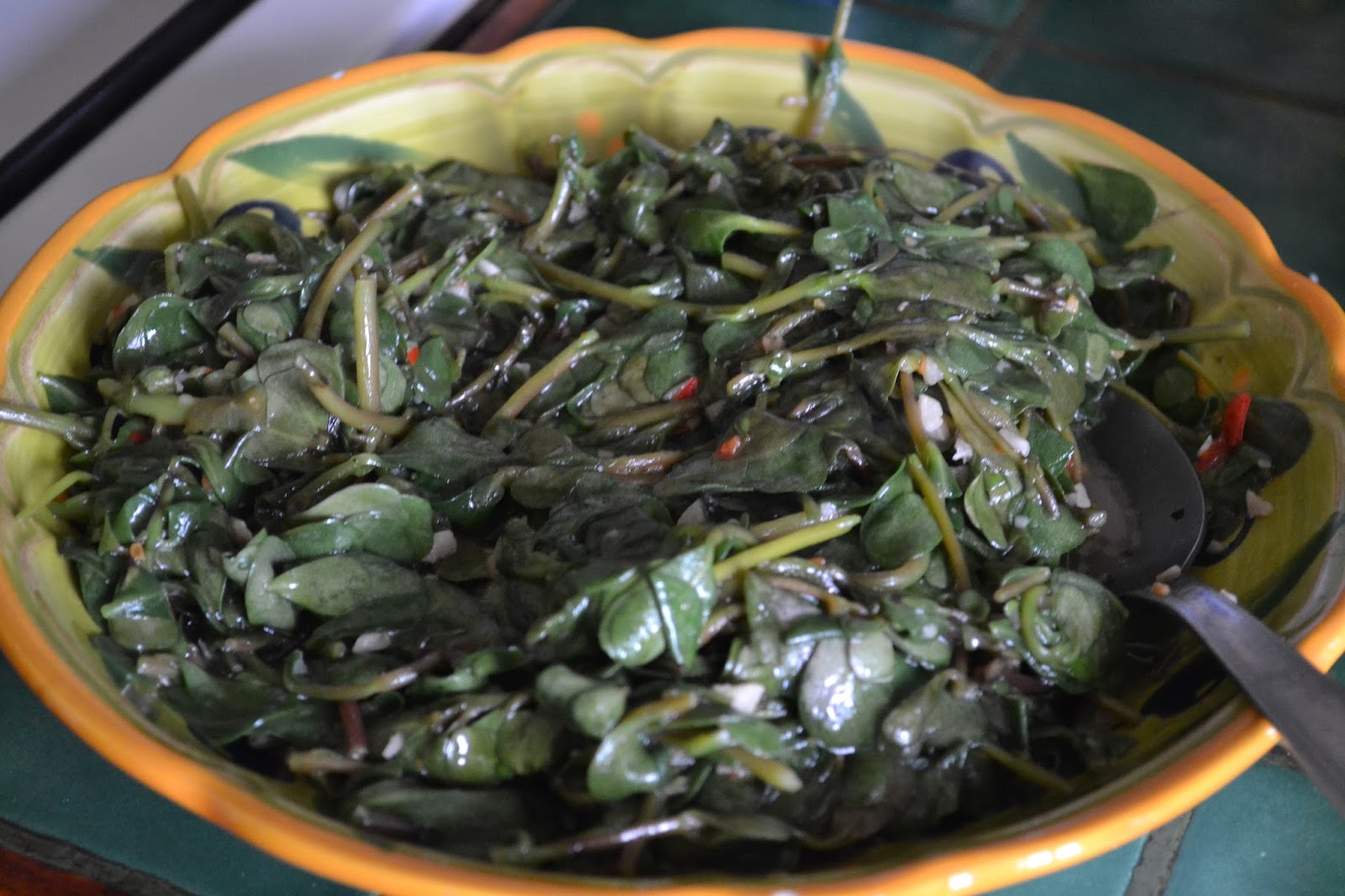
There’s been no rain for two weeks now, but the purslane just keeps coming. It’s time to yank some up and cook it. Everyone who has ever used the stuff recommends picking it in the morning. The plant employs an unusual sort of photosynthesis; it does its work at night, storing up nutrition in the form of a slightly acidic chemical, which it converts to sugars over the course of the day. Get it in the morning while it’s still tart.

This we do. We have to cut off the roots and soak it; growing next to the ground it picks up a lot of dirt. Italians have been eating porcellana (also called portulaca) forever. The Milanese Bonvesin de la Riva mentions it in his list of foods in his 1288 Marvels of the City of Milan.  But we haven’t found a lot of compelling recipes for it.  So we try it the most common way: like any other green, sautéed with a little garlic and olive oil (and a chopped chilli, because that’s the way we are). It looks about like any other green when it’s done, but I have to admit we were a little disappointed by the taste. The tartness disappeared, and a  blandness replaced it. Fortunately we didn’t cook it too long. That’s the worst mistake you can make; after about five minutes on the stove a sort of gluey texture starts to emerge—not nice. Five minutes is just about right.


            One cookbook suggests making a sauce for meat or fish: mash up a bunch of it, with an egg white, an anchovy and some oil. Others remind us that  the country folk used to make it  sott’aceto, preserved in vinegar. Everyone else seems to limit it to salads: with cucumber, with tomato, beetroot, beans, lentils or whatever.  There’s a nice one (in Italian) involving cold chicken, basil, pistachios, shaved grana padano and red currants.

            Bottom line—it’s absolutely fine in salads, though it will never be a star. You can leave the smaller stems in, and there doesn’t seem to be any difference in taste between the young shoots and the full-grown monsters.

            The Italians haven’t provided much inspiration, so we looked to see what the French do with their pourpier. Back in Roman times, Pliny oddly referred to it as ‘Gallic asparagus’, which suggests it was somewhat prized. And Gallic pourpier, after all, is what’s menacing my garden. But the French were no help; all they do is purée it for a soup, a velouté, like they do with everything else.

Next year the purslane will certainly be back, and we’ll be trying  a Mexican favourite, pork and purslane, or the Lebanese salad called fattoush, with lots of mint and lemon juice,  or this very intriguing Indonesian salad.

Finally, all you gardeners be advised that purslane has an evil twin. The false purslane is called ‘creeping spurge’. it is nearly as common and mildly toxic. Almost as soon as I learned this I noticed, yes indeed, we’ve got that in the garden too. But the leaves are smaller and flatter, and grow in pairs. It’s not hard at all to tell the difference


12 August 2013

The Naked and the Ill-formed


It won’t be love at first sight. Even a glowing description wouldn’t set your taste buds on fire. But you won’t be sorry you tried them. Malfatti means ‘badly made’, and the charm of these dumplings seems to be in squeezing them into shape by hand any which way—they’re never supposed to be completely tidy and uniform like their cousins, the gnocchi (in some corners of the northwest they sometimes call them gnocchi verdi, ‘green gnocchi’).

            Essentially, a malfatto is the common stuffing used for ravioli or tortelli: spinach and ricotta, bound with eggs, and some nutmeg and parmesan thrown in—only without the pasta cover.  In much of Tuscany, the same thing is logically called gnudi, or ‘nudies’ (malfatti in Siena, gnudi in Florence ; it’s a local thing). Some restauranteurs in Napa, California claim that their mother invented them in 1925, but the Italians say they come from Lombardy, where they’ve been making them for centuries.

            They’re pretty trendy now, both in Italy and the U.S. Malfatti are easy to make, and offer a great alternative to pasta for a primo, or a good lunch all by themselves along with a salad.  The most popular recipe has them with slightly browned butter and sage on top. They’re perfect like that, but up in Lombardy they will also put mushrooms cooked in butter on top, or even a tomato and meat ragú.

Here’s Dana’s basic recipe for malfatti:

This recipe is very forgiving,  and can be easily adjusted to what you have in the garden or fridge.


1 firmly packed cup of greens (whatever you have in the garden will work; this one is a mix of chicory, chard, amaranth and spinach); boiled,  drained, squeezed and finely chopped

garlic cloves, minced (if you like garlic, put in five; if you don't put in less)

1/2 cup green onions or chives, or both, minced

a handful of fresh basil leaves (if you have them)

250 gr ricotta

1/2 cup grated Parmesan

1 cup breadcrumbs or flour. Breadcrumbs make a lighter version

a big pinch of nutmeg

2 eggs, beaten

salt and pepper to taste

flour for dredging

5 tbs butter

a dozen or more sage leaves

grated Parmesan


—Sauté the garlic in a bit of olive oil and mix in the greens.

—Mix in the onions/chives, ricotta, Parmesan, breadcrumbs, garlic, nutmeg, eggs, salt and pepper to make a stiff dough. Refrigerate for a few hours or overnight.


—Preparation: heat salted water to a boil as you roll the dough into logs about 4cm in diameter on a floured surface. Slice, making sure each dumpling is lightly coated with flour, and drop into boiling water (it usually takes four or five batches). Take them out as they float to the surface and put under a low grill to keep warm and lightly brown while cooking the other batches.  This light grilling, it must be said, is not canonical, but it gets rid of the slightly slimy surface and makes the malfatti much nicer,  at least at our house.

—Meanwhile gently heat the butter and sage until the butter is light brown and sage turns dark. Drizzle over the malfatti, top with Parmesan and serve warm.


Here’s a recipe that may more nearly approximate the original rustic malfatti, with old bread soaked in milk instead of flour or breadcrumbs (recipe in Italian here


10 August 2013

The App’s Finally Out


Well, we did it. Apple has just OK’d our baby for the App Store, and we’ll just sit back and wait and see if anyone notices. A long-treasured bottle of Barolo fell victim to our little celebration.

The Italian Menu Decoder was some three years in the making. Not that we worked on it all the time; it was something we took up to fill any time we had between jobs.  But it was addictive. One thing always led to another. Take milza, or spleen (of a calf). Couldn’t leave that out; in Umbria they grind it up and put it on little toasts as bruschetta—it’s actually delicate and quite tasty. That reminded us of the pan ca meusa, spleen and cheese sandwiches, we tried long ago in the famous Antica Focaccia San Francesco in Palermo. Now, that old standby is famous and has its own website, which reminded us we had to explain sfinciuni, panelle and cazzilli, and a few other things too.

And a Palermo market cheese sandwich (usually caciocavallo—I check to see if we have that word yet) can be schietta, plain, or maritata.  ‘Married’ means with spleen.  Maritata can mean a lot of things around the Mezzogiorno. We didn’t know that in Naples they call a soup minestra maritata if it has meat in it, ‘married’ to the vegetables.

            And schietta made us think of the Greek sketo, which is what you say there when you don’t want any sugar in your frappé. It was a surprise to find so many old Greek words hiding among the Italian. In Venetian dialect (and Bergamasco and Triestino and no doubt many others) a fork is a pirón instead of a forchetta. And rightly so; after all, the Byzantines invented them.

            See what I mean?

            It never stops. Never. Most likely we will be working on this app for the rest of our days. I’ve added two words to it since I started writing this post—cimino, I noticed, is Sicilian for sesame seeds, which will be on the soft roll locally called a mafalda; the Palermitani prefer these with their spleen.

            We’ve learned a lot, most of which we of course forget—after some thirty years of being confused by Italian words for seafood, we still often can’t tell which fish is which. Worst of all, the Italians are diabolically clever people, nowhere more than in the kitchen, and at times we suspect that they might be coming up with new words faster than we can pin down the old ones.

            Right now we have checked it against various lists and we think we have just about everything. There was a last minute panic before the release when we realized we had forgot—spinach.

            Not having a staff of culinary lexicographers at our command, we might slip up here and there. And with a subject where everyone and every village has its opinion of what’s right, we expect to get a lot of mail. That, in fact, is just what we’re hoping for. One of the reasons for starting this blog is to start a big discussion about all these subjects, to hear from those who know while exploring the secrets of regional and traditional cooking from every corner of Italy. If you have any corrections, amplifications, emendations, recipes or stories to tell, do drop us a line!